Sharp Cocorobo Vacuum Cleaner Robot
" Speech recognition, automatic cleaning
Imagine a vacuum cleaner that communicates with its owner and you'd think you were in the pages of a whimsical science fiction movie. No, not any more. Sharp has developed Cocorobo, a household vacuum cleaner with artificial intelligence that can recognize speech commands in English and Japanese. Equipped with a 1.3-megapixel camera and obstacle-avoidance sensors, Cocorobo can be left to clean the room by itself, meaning you are free to do other things.
 
It also has wireless LAN connection so can be controlled remoted by an owner's Android smartphone or iPhone, and the makers haven't skimped on the cleaning functionality either: There are five different cleaning modes and a powerful central fan that can sweep up all the dust and dirt on the floor, while releasing Plasmacluster Ions that cleanse the room. Part pet robot, part sophisticated cleaning machine, Cocorobo will become not only an essential tool for your home, but a part of your family. "
source:
http://www.japantrendshop.com/sharp-cocorobo-vacuum-cleaner-robot-p-1424.html
Festo's SmartBird robot takes off.
" The geniuses at Festo's Bionic Learning Network are well known for their fascination with robotic animals, and their latest creation is no exception. Dubbed the SmartBird, this autonomous bionic bird -- modelled on herring gulls -- graces the sky with its sophisticated two meter-long wings, which utilize a bending torso for lifelike directional control. What's more, this robot is also capable of taking off and landing on its own, but it can also be controlled and monitored from afar using ZigBee radio. Amazingly, all of this round up to just one pound, meaning the SmartBird can happily float about with moderate flapping. Jump past the break for some agile in-flight action, accompanied by an animation detailing the inner workings. "
source: festo
Toyota's robot nurses of the future
" With a shortage of nurses predicted for the future, Japanese motor giant Toyota has revealed its own solution to the problem: robots. Back in 2007, the auto manufacturer began a new initiative aiming to develop robots that could integrate into everyday life, called the Toyota Partner Robot program. Since then, we've seen them used for personal transport, playing violin, and even heard plans to send them to the moon. However, the latest developments promise to improve rehabilitation of injured or sick patients, helping with walking, balance, and posture; along with aiding in transferring patients between beds. There are four different designs in all — one combats lower-leg paralysis (pictured above right); another takes body weight to reduce stress on a patient's knee and lower leg; one employs a Segway-like device to help improve balance; and the last (pictured above left) aims to make lifting patients easier for nurses.
Earlier today, we heard that researchers elsewhere in Japan are looking at the potential for robots to help nurse the elderly and disabled, and we've also seen Honda developing robotic walking assistance. However, in contrast with these other programs, Toyota's already aiming towards commercialization — expect to see these in 2013."
source: Toyota
Paro Robot Seal Healing Pet
World's Most Therapeutic Robot
" Paro is the most interactive "healing pet" made to date, designed to be used for animal therapy without needing actual animals that require special attention. It learns from you, and feels just like a real, lovable pet in its natural responses.
Paro is modeled on a baby seal and we're sure you agree looks super cute! It has been approved by Guiness World Records as the most effective therapeutic pet of its kind. Incredibly soft and lifelike, Paro has an array of sensors, and develops a personality over time that corresponds with how people play with Paro. Now available in white or gold.
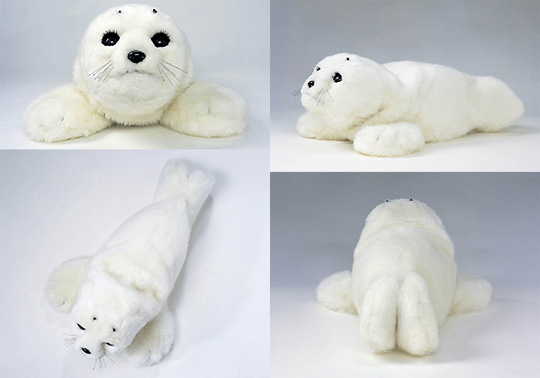
Paro's Functions:
- Diurnal rhythm of morning, afternoon, and night
- Five kinds of sensors: tactile, light, audition, temperature, and posture
- Can recognize light and dark
- Can feel being stroked and the amount of pressure
- Understands when it is being held
- Can recognize the direction of sound
- Recognizes its name, greetings, and praise
- Remembers interactions and adapts
- Imitates the voice of a real baby seal
- Expresses feelings though noises, body movements, and facial expressions
Paro's Robotic Movements:
- Moves head multi-directionally
- Moves flippers (front and rear)
- Creates highly emotional facial expressions with blinking eyes
- Each Paro's facial expressions are unique
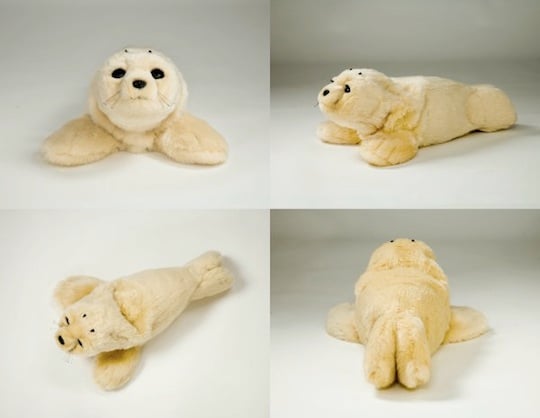
Paro features:
- Color: white or gold
- Durable yet soft artificial fur which is anti-bacterial and soil resistant
- Strong internal robotics that can handle long-term use
- Has an electromagnetic shield (safe for pacemakers)
- Manual (English and Japanese)
- Pacifier charger (pink and yellow)
- Internal rechargeable battery
- Power: AC100V, 50-60Hz, 1.3-0.7A
- Length: 57cm (22.4")
- Weight: about 2.7kg (95.2 oz) . "
source: Paro
'nao' programmable humanoid robot
" France-based aldebaran robotics company has just released the next-generation model of its 'nao' programmable humanoid robot. standing 1.9 feet tall (57-centimeters), 'nao' sees via high-resolution cameras and can understand and localize both visual and audio input, permitting it to communicate with users in eight different languages as well as walk and learn via built-in algorithms.
In comparison to its predecessor, the new model of 'nao' features a higher-power 1.6 GHz Intel processor capable
of handling two HD video streams simultaneously and thereby of completing identification tasks more quickly.
a new speech recognition software called nuance improves communication, while the robot's physical movements
have been optimized as well as improved with collision avoidance.
'nao' uses four microphones to track sounds, communicating in eight languages via voice recognition and text-to-speech technology. the multiple audio sensors are utilized for sound localization, as any noise will hit each at different times, and 'nao' can calculate from this data the location of the subject.
The robot sees via two 920-pixel cameras-- one at its forehead for a general view of scenes and the second at mouth level to scan the more immediate environment. both are capable of capturing up to 30fps. internal algorithms offer face and shape recognition, including the capacity for learning, and the visual feeds can also be transmitted to external devices.
Capacitive sensors on the top of the robot's head permit users to communicate via touch, pressing or tapping in diverse patterns to trigger prespecified actions.

the robot can understand and communicate in eight different languages

view of the robot in action
Featuring prehensile hands, 'nao' is capable of grasping a range of objects. it can also walk on a variety of floor surfaces, easily transitioning from one to another. when 'nao' loses its balance, the robot's 'fall manager' system cancels all current motion tasks, puts the robot's arms in a protective position, and lowers its stiffness measurement to zero to prevent damage.

construction diagram
Supporting wi-fi and ethernet 'nao' is also completely programmable. developers have written programs wherein
'nao' can offer a personalized weather report or connect and stream internet radio. the robot is also capable of processing infrared transmissions, permitting devices to communicate with one another and with many domestic appliances. "
|
|
|

